Talks and Poster Presentations
Talks
- Title: Emergent Material Properties in Biomolecular Condensates: From Viscoelasticity to Aging and Fibrillation[+] AbstractBiomolecular condensates formed via liquid–liquid phase separation are increasingly recognized as dynamic, functional compartments whose material properties are encoded by molecular sequence and modulated over time. While many condensates remain fluid-like, others undergo aging and transition into viscoelastic, gel-like, or solid-like states, often associated with pathological aggregation. Understanding the physical mechanisms governing these transitions remains a central challenge. In this talk, we present a unifying framework that connects molecular-scale mechanisms of aging \cite{biswas2024molecular}, sequence-encoded interactions \cite{biswas2025decoding}, and non-equilibrium flux-driven processes \cite{biswas2026amiloyed} to the emergent material behavior of biomolecular condensates. First, using an energy landscape approach, we show how the organization of sticker interactions along polymer sequences-characterized by periodicity and disorder-controls the balance between viscous and elastic responses. Second, we demonstrate how aging processes, including solvent depletion, chain rigidification, and the lifetime of sticker interactions, drive a transition from liquid-like to elastic and solid-like behavior, with distinct viscoelastic signatures. Finally, we introduce a non-equilibrium simulation framework that reveals how molecular flux and sequence-encoded $\beta$-prone motifs cooperatively drive amyloid nucleation at condensate interfaces, leading to diverse growth morphologies and arrested states. Together, these results establish biomolecular condensates as evolving soft materials whose fate is governed by the interplay of sequence, mechanics, and fibrillation. This perspective provides a unified physical basis for understanding functional organization and pathological solidification in intracellular condensates.
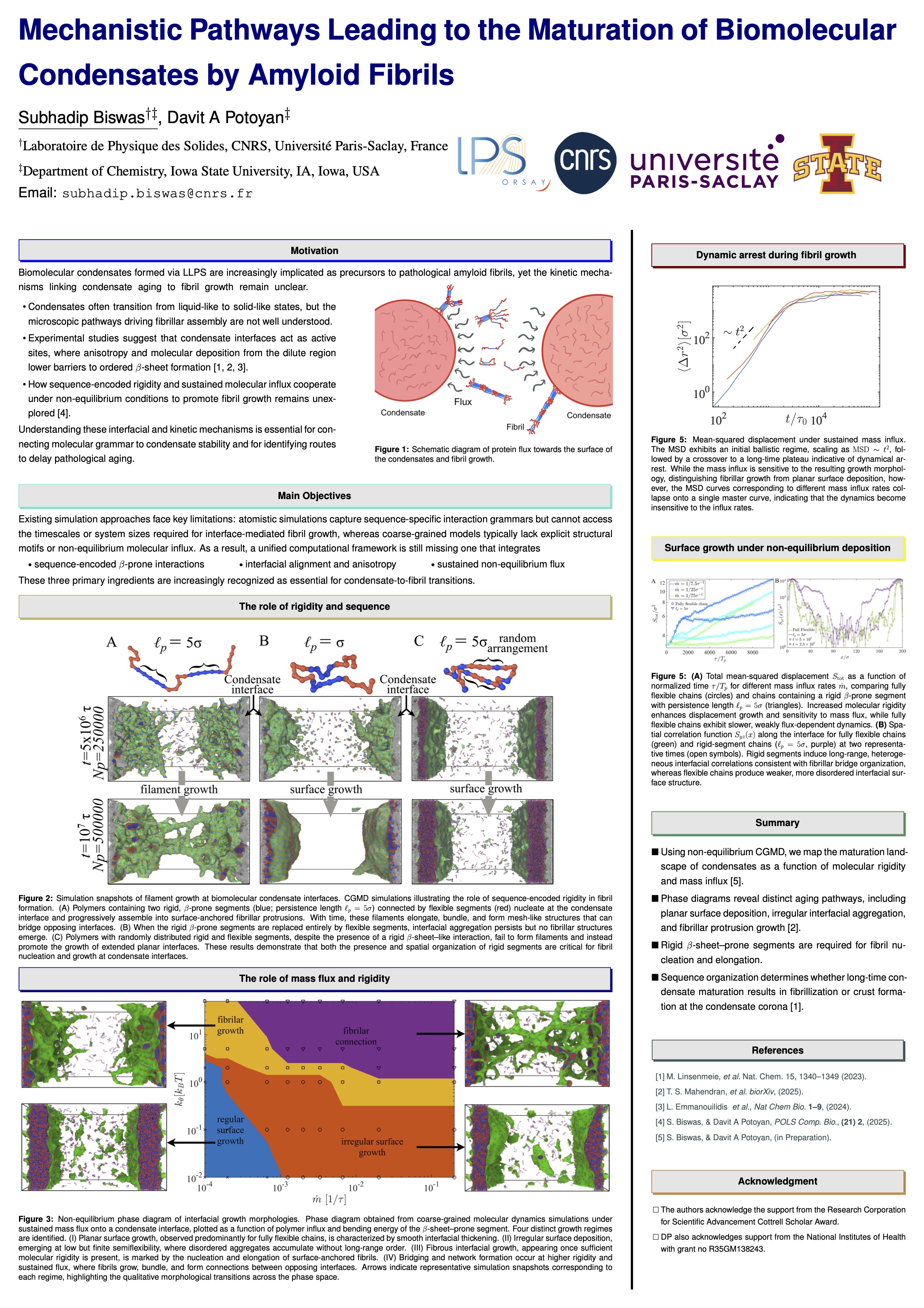
- Title: Mechanistic Pathways Leading to the Maturation of Biomolecular Condensates by Amyloid Fibrils[+] AbstractBiomolecular condensates formed via liquid–liquid phase separation are typically described as liquid-like assemblies with fast internal dynamics. However, recent experimental studies show that these condensates age over time. Initially liquid, they gradually slow down, their relaxation times increase, and they become more viscoelastic. Importantly, experiments also show that aging condensates often develop a crust-like corona around their surface, and in some cases they form amyloid-like fibrillar structures. Despite these observations, the mechanism by which fibrils emerge from condensates remains unclear. To address this, we introduce a minimal, non-equilibrium coarse-grained molecular dynamics model to qualitatively uncover possible mechanistic pathways for fibril formation. In our model, molecules contain rigid, β-sheet–like segments connected by flexible chains. When these molecules are deposited onto condensate interfaces, the rigid segments preferentially align, nucleate at the surface, and grow into mesh-like structures that elongate into long fibrillar filaments. Crucially, when we remove the rigid β-prone segments, fibrils no longer form—only disordered surface aggregation is observed. This behavior is consistent with experimental findings. Furthermore, when we modify the interaction patterns, fibrillar growth is suppressed and instead we observe surface thickening, resembling crust formation around the condensate. Overall, our results suggest that sequence-encoded rigidity and interfacial non-equilibrium conditions are key determinants of whether condensates fibrillize or remain liquid-like.
- Title: Uncovering material properties of biomolecular condensates via energy landscape framework of stickers and spacers[+] AbstractA significant fraction of eukaryotic proteins contain low-complexity sequence elements with unknown functions. Many of these sequences are prone to form biomolecular condensates with unique material and dynamic properties. Mutations in low-complexity regions often result in abnormal phase transitions into pathological solid-like states. Therefore, understanding how the low-complexity sequence patterns encode the material properties of condensates is crucial for uncovering the cellular functions and evolutionary forces behind the emergence of low-complexity regions in proteins. In this work, we employ an alphabet-free energy landscape framework of the stickers and spacers to dissect how the low complexity patterns of proteins encode the material properties of condensates. We find a broad phase diagram of material properties determined by distinct energy landscape features, showing that periodic repeat motifs promote elastic-dominated while random sequences are viscous-dominated properties. We find that a certain degree of sticker periodicity is necessary to maintain the fluidity of condensates, preventing them from forming glassy or solid-like states. Finally, we show that the energy landscape framework captures viscoelastic trends seen in the recent experiments on prion domains and makes predictions for systematic variation of protein condensate viscoelasticity via altering the periodicity and strength of sticker motifs.
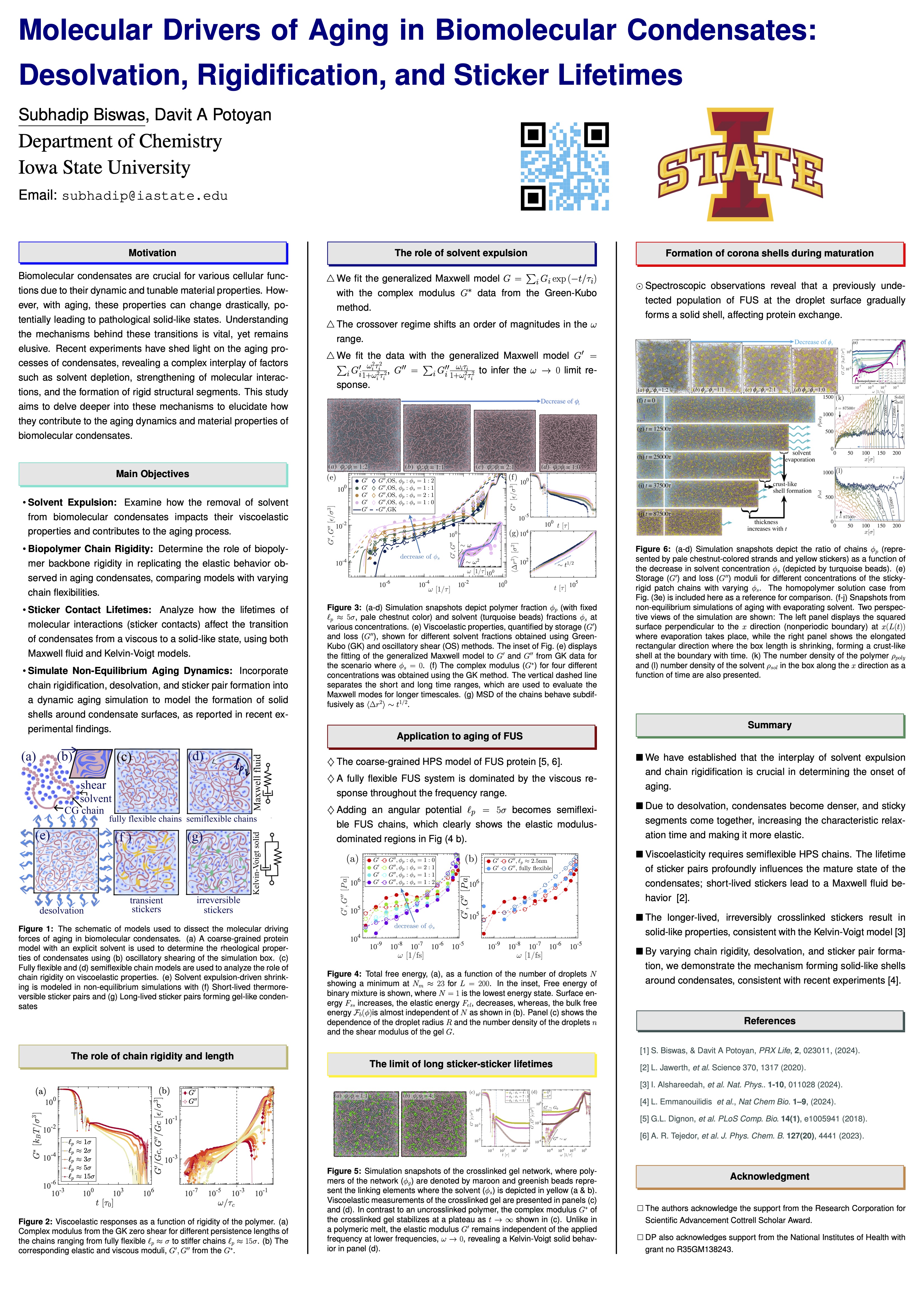
- Exploring the Viscoelasticity and Aging Dynamics in Biomolecular Condensates: Bridging Polymeric Systems and Gel Networks[+] AbstractBiomolecular condensates are dynamic structures within cells characterized by their changing rheological properties over time. Recent research suggests that the aging and maturation of these condensates are influenced by a complex interplay involving the depletion of solvent, the formation of connections between molecules (referred to as sticker links), and the development of rigid structural elements such as beta fibrils. In this study, we employ various simplified models of biopolymers to investigate how solvent evaporation, the stiffness of biopolymer chains, and the lifetimes of connections between molecules affect the viscoelastic properties and aging dynamics of condensates. Our results indicate that the stiffness of the biopolymer backbone is crucial for reproducing the dominant elastic behavior observed in experimental studies. Conversely, models using completely flexible chains, a common assumption in simulations of intrinsically disordered proteins, fail to exhibit a prominent elastic regime. We also show that changing the solvent content within condensates influences the transition between storing and dissipating energy, suggesting that solvent evaporation significantly contributes to condensate aging by shifting from a viscous to an elastic state. Moreover, the duration of connections between molecules significantly impacts the mature state of condensates; short-lived, reversible connections lead to behavior similar to a Maxwell fluid, whereas longer-lasting, irreversible connections result in solid-like properties, consistent with the Kelvin-Voigt model. Finally, by integrating chain stiffness, solvent evaporation, and connection formation into a dynamic simulation of aging, we elucidate the molecular mechanism behind the formation of solid shells around condensate surfaces, as observed in recent experimental findings.
- Studying material properties of bio-soft matter systems: Using MD simulations[+] AbstractUnderstanding the physical and mechanical properties of bio-soft matter—such as proteins, lipid bilayers, and hydrogels—is critical for advancing fields from biomedical engineering to materials science. In this workshop, we explore how molecular dynamics (MD) simulations can be used to study these complex systems at the atomic scale. Participants will be introduced to the foundational principles of MD simulations and guided through practical examples, including system setup, force field selection, and analysis of key properties like diffusion, conformational stability, and mechanical response. The session is designed to be accessible to newcomers while providing valuable insights for researchers aiming to integrate MD into their work on bio-soft materials.
- Molecular Origin of Aging in Biomolecular Condensate[+] AbstractBiomolecular condensates represent intriguing, dynamic assemblies within cells whose rheological properties evolve over time. We investigate the aging of biomolecular condensate and modeled condensates as solvent evaporation systems that impact viscosity using Coarse-grained (CG) molecular dynamics simulations. By varying solvent concentrations in bulk condensed systems, we unveil distinct frequency regimes in which the storage (G') and loss (G") moduli intersect and their crossover regions. Solvent expulsion brings sticky regions closer, shifting from a fluidic to elastic nature in the intermediate deformation frequencies. Comparing elastic and viscous moduli and viscosity, we observe distinct rheological variations in the case of dry entangled polymer melt, in a solvent and while it forms crosslinked gel structures. We also show decreasing polymer chain length correlates with a reduction of viscosity, whereas long chains with excessive frictions and large entanglements make the system more viscous. We found fully flexible chains exhibit viscous dominance throughout the frequency range. However, introducing rigidity renders the interesting elasticity-dominated viscoelastic nature of the system. We reveal the Maxwell fluidic nature of the biomolecular condensates, which was not captured in the previous simulations studies. This comprehensive study sheds light on the aging of the biomolecular condensates and how the rheological nature changes over time.
- Properties of Polymer under Soft Confinement[+] AbstractExplored the equilibrium morphology of a semiflexible polymer inside a soft tubule whose lateral dimension is much smaller compared to the radius of gyration of the chain. As a function of the rigidity of the tube we observed a coil to globule transition of the chain in addition we observed a novel oblate spheroid to a toroidal coil shape transition as a function of chain stiffness.
Posters
- Equilibrium Phases of Soft Macromolecular Confinement[+] AbstractA significant fraction of eukaryotic proteins contain low-complexity sequence elements with unknown functions. Many of these sequences are prone to form biomolecular condensates with unique material and dynamic properties. Mutations in low-complexity regions often result in abnormal phase transitions into pathological solid-like states. Therefore, understanding how the low-complexity sequence patterns encode the material properties of condensates is crucial for uncovering the cellular functions and evolutionary forces behind the emergence of low-complexity regions in proteins. In this work, we employ an alphabet-free energy landscape framework of the stickers and spacers to dissect how the low complexity patterns of proteins encode the material properties of condensates. We find a broad phase diagram of material properties determined by distinct energy landscape features, showing that periodic repeat motifs promote elastic-dominated while random sequences are viscous-dominated properties. We find that a certain degree of sticker periodicity is necessary to maintain the fluidity of condensates, preventing them from forming glassy or solid-like states. Finally, we show that the energy landscape framework captures viscoelastic trends seen in the recent experiments on prion domains and makes predictions for systematic variation of protein condensate viscoelasticity via altering the periodicity and strength of sticker motifs.
- Equilibrium Phases of Soft Macromolecular Confinement[+] AbstractA significant fraction of eukaryotic proteins contain low-complexity sequence elements with unknown functions. Many of these sequences are prone to form biomolecular condensates with unique material and dynamic properties. Mutations in low-complexity regions often result in abnormal phase transitions into pathological solid-like states. Therefore, understanding how the low-complexity sequence patterns encode the material properties of condensates is crucial for uncovering the cellular functions and evolutionary forces behind the emergence of low-complexity regions in proteins. In this work, we employ an alphabet-free energy landscape framework of the stickers and spacers to dissect how the low complexity patterns of proteins encode the material properties of condensates. We find a broad phase diagram of material properties determined by distinct energy landscape features, showing that periodic repeat motifs promote elastic-dominated while random sequences are viscous-dominated properties. We find that a certain degree of sticker periodicity is necessary to maintain the fluidity of condensates, preventing them from forming glassy or solid-like states. Finally, we show that the energy landscape framework captures viscoelastic trends seen in the recent experiments on prion domains and makes predictions for systematic variation of protein condensate viscoelasticity via altering the periodicity and strength of sticker motifs.
- Transport through bacterial nanopores and nanochannels[+] AbstractA significant fraction of eukaryotic proteins contain low-complexity sequence elements with unknown functions. Many of these sequences are prone to form biomolecular condensates with unique material and dynamic properties. Mutations in low-complexity regions often result in abnormal phase transitions into pathological solid-like states. Therefore, understanding how the low-complexity sequence patterns encode the material properties of condensates is crucial for uncovering the cellular functions and evolutionary forces behind the emergence of low-complexity regions in proteins. In this work, we employ an alphabet-free energy landscape framework of the stickers and spacers to dissect how the low complexity patterns of proteins encode the material properties of condensates. We find a broad phase diagram of material properties determined by distinct energy landscape features, showing that periodic repeat motifs promote elastic-dominated while random sequences are viscous-dominated properties. We find that a certain degree of sticker periodicity is necessary to maintain the fluidity of condensates, preventing them from forming glassy or solid-like states. Finally, we show that the energy landscape framework captures viscoelastic trends seen in the recent experiments on prion domains and makes predictions for systematic variation of protein condensate viscoelasticity via altering the periodicity and strength of sticker motifs.